

Top 10 ETFs in India: 2026 Proven Essential Wealth Guide
Imagine standing at a crowded railway station in Mumbai, trying to decide which train will get you to your destination the fastest without breaking the bank. The world of investing feels remarkably similar. You are likely a hardworking professional, juggling meetings and family commitments, with little time to micro-manage every single stock in your portfolio. You want your money to work as hard as you do, but the sheer volume of choices—thousands of stocks and hundreds of mutual funds—can feel paralyzing.
This is exactly why the Top 10 ETFs in India have become the “local trains” of the financial world: reliable, cost-effective, and designed to move you toward your destination with collective strength. Exchange-Traded Funds (ETFs) have revolutionized the way Indians look at the stock market. Instead of betting on a single horse, you are essentially betting on the entire stable. In this guide, we will break down the giants of the ETF space and show you how to use them to build a legacy.
Key Takeaways
- Size Matters: High Assets Under Management (AUM) usually indicates better liquidity and lower tracking errors.
- Diversification is Key: The top ETFs cover everything from Large Caps and Banking to Gold and Silver.
- Cost Efficiency: ETFs generally offer lower expense ratios compared to active mutual funds, making them ideal for long-term wealth creation.
- Ease of Access: You can buy and sell these on the stock exchange just like individual shares through a Demat account.
Understanding the Power of the Top 10 ETFs in India
To understand the Top 10 ETFs in India, think of a fruit basket. If you buy one apple and it turns out to be rotten, you’ve lost your investment. But if you buy a basket that represents the best harvest of the season, a single bruised fruit won’t ruin your snack. An ETF tracks an index—like the Nifty 50 or the BSE Sensex—and mirrors its performance.
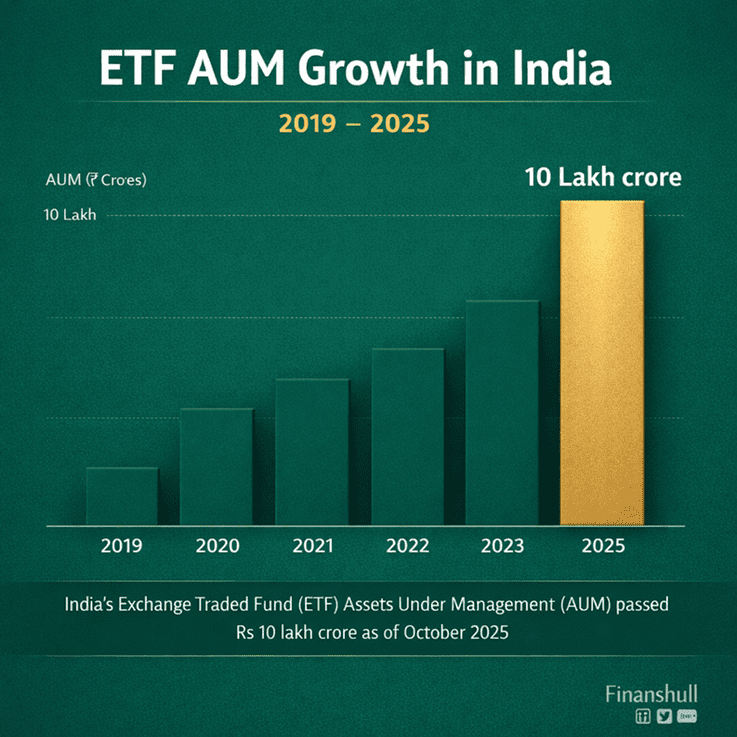
When we look at the Top 10 ETFs in India by AUM (Assets Under Management), we are looking at where the smartest “big money” is parked. High AUM is a sign of trust and, more importantly, liquidity. Liquidity ensures that when you want to sell your units to fund a dream home or a child’s education, there is always a buyer on the other side. As of March 2026, the concentration of wealth in large-cap and sector-specific ETFs shows a clear trend: Indian investors are seeking stability combined with the growth of the nation’s biggest enterprises.
Want quick, daily insights on personal finance? Join our community on Instagram @finanshull for bite-sized tips.
The 2026 Leaderboard: Top 10 ETFs in India by AUM
Below is the definitive list of the Top 10 ETFs in India, based on data as of March 27, 2026. These funds represent the backbone of passive investing in the Indian context.
| Name | AUM (in Crore) | Focus |
| UTI Nifty 50 ETF | 65,573 | Large Cap |
| UTI BSE Sensex ETF | 51,175 | Large Cap |
| Kotak Nifty Bank ETF | 4,519 | Financials |
| UTI Gold ETF | 3,977 | Gold |
| UTI Nifty Bank ETF | 3,463 | Financials |
| Kotak Nifty 50 ETF | 3,100 | Large Cap |
| Kotak Nifty PSU Bank ETF | 2,251 | Financials |
| UTI Nifty Next 50 ETF | 2,071 | Large Cap |
| UTI Silver ETF | 1,308 | Silver |
| Kotak Nifty Alpha 50 ETF | 686 | Total Market |
Source: Trading View. Data as on 27 March 2026.
The Elephant in the Room: Direct vs. Regular Plans
As you explore the Top 10 ETFs in India, you will notice that ETFs are traded directly on the exchange. This brings up a vital debate: Can you do it all yourself, or do you need a partner? At Nemi Wealth, we believe in rational education. If you have the hours to study tracking errors, rebalancing frequencies, and tax-loss harvesting, the DIY route is a viable path.
However, for most people, the challenge isn’t buying the ETF—it’s staying invested when the market drops 10% in a week. This is where the “Regular” philosophy comes in. While ETFs are inherently “direct” in their market execution, the surrounding strategy—asset allocation, emotional coaching, and goal-mapping—is what Nemi Wealth provides. We ensure that your investment in the Top 10 ETFs in India isn’t just a random collection of symbols, but a structured response to your life goals.
Investing without a plan is just gambling with better vocabulary. A regular plan through a partner provides the “human firewall” against impulsive decisions that could derail your compounding journey.
Actionable Steps to Build Your Strategy
Identifying the Top 10 ETFs in India is just the beginning. Now, you must weave them into a functional financial garment. At Nemi Wealth and Finanshull, we suggest a three-step approach to using these instruments effectively.
Step 1: Protect the Downside
Before you buy into the Top 10 ETFs in India, ensure your foundation is solid. This means having appropriate insurance covers incliding Term Insurance policy and Comprehensive Health Insurance. Wealth creation is a marathon; you cannot finish the race if a medical emergency wipes out your capital. According to guidelines from SEBI, investor protection begins with risk management. Click here to protect your wealth.
Step 2: Build the Core
Use the heavyweight champions from the Top 10 ETFs in India list to build your core portfolio. Funds like the UTI Nifty 50 ETF or the UTI BSE Sensex ETF provide exposure to India’s top 50 or 30 companies. These are the engines of the economy. By allocating 60-70% of your equity portfolio here, you capture the steady growth of India Inc. while keeping your management costs incredibly low.
Step 3: Diversify for Alpha
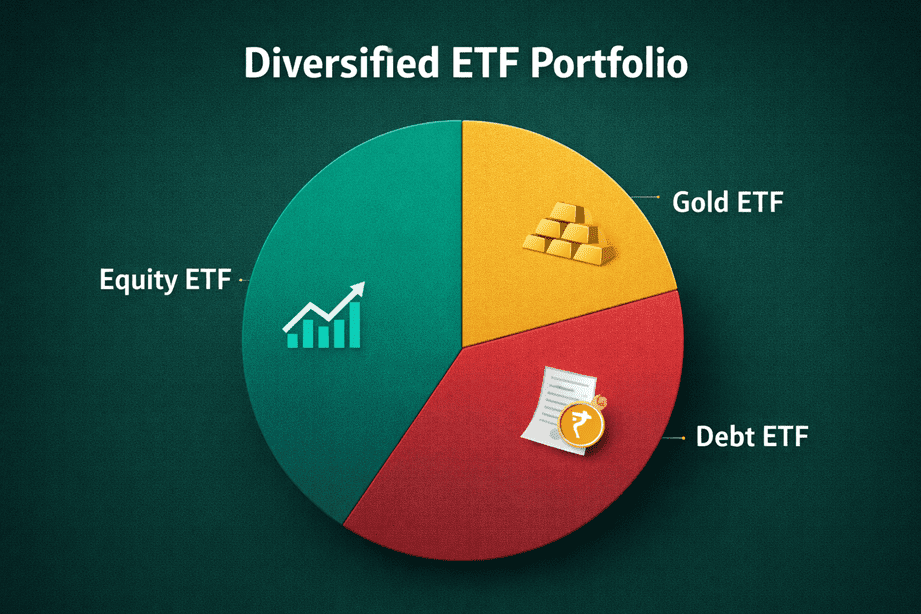
Once your core is set, look at the specialized players in the Top 10 ETFs in India. Are you bullish on the banking sector? The Kotak Nifty Bank ETF is your tool. Want to hedge against inflation? The UTI Gold ETF and Silver ETF offer a digital, liquid way to hold precious metals. For those seeking higher growth, the Kotak Nifty Alpha 50 ETF targets high-momentum stocks, providing that extra “alpha” or outperformance.
The Bottom Line
The rise of the Top 10 ETFs in India marks a shift in investor psychology—from chasing “hot tips” to embracing systematic, low-cost growth. Whether you are leaning on the stability of the Nifty 50 or diversifying into Gold and Silver, these instruments provide a transparent and efficient path to wealth. Remember, the best time to start was yesterday; the second-best time is today. By combining the logic of ETFs with the strategic oversight of a dedicated partner, you turn “saving money” into “building a legacy.”
Ready to own the Top 10 ETFs in India? Don’t let market hours pass you by while you’re stuck on the sidelines. To start building your passive income engine with the speed and discipline of a pro, you need a platform that’s as fast as the Nifty 50 itself. Open your free Demat account instantly here and start your ETF journey today.
Do I need a Demat account to buy the Top 10 ETFs in India?
Yes, unlike traditional mutual funds where you can invest via a folio, ETFs are traded on the stock exchange (NSE/BSE). Therefore, a Demat and Trading account is mandatory to buy or sell units of the Top 10 ETFs in India.
How are ETFs different from Index Funds?
While both track an index, ETFs are traded throughout the day at fluctuating prices. Index Funds are bought and sold at the end-of-day NAV. For those who want the flexibility to trade during market hours, the Top 10 ETFs in India are the preferred choice.
Is the AUM the only thing I should look at?
While AUM is a major factor in our list of the Top 10 ETFs in India, you should also look at the “Tracking Error.” This measures how closely the ETF follows its index. A lower tracking error means the fund manager is doing a great job of mirroring the index.
What are the tax implications of investing in ETFs?
Equity ETFs (like Nifty 50 or Bank Nifty) are taxed like equity shares: 15% for Short-Term Capital Gains (STCG) and 10% for Long-Term Capital Gains (LTCG) exceeding ₹1.25 lakh (as per recent budget norms). Gold and Silver ETFs have different tax treatments often aligned with debt structures or your income slab, depending on holding periods.
Can I start a SIP in the Top 10 ETFs in India?
Absolutely. Most modern broking platforms allow you to set up a “Stock SIP,” where a fixed amount or quantity of ETF units is purchased automatically every month. This is a fantastic way to practice rupee-cost averaging. Click here to invest now.