

REITs vs Fractional Ownership: 5 Smart Ways to Superior Yields in 2026
For the modern Indian investor, the dream of “owning a piece of the city” has shifted from dusty land titles to digital ledger entries. If you are a high-earning professional or an HNI, you’ve likely felt the frustration of traditional real estate: it’s illiquid, management-intensive, and requires massive capital.
The rise of REITs vs Fractional Ownership has changed the game, offering a gateway into Grade-A commercial property investment with a fraction of the cost. But as we move through 2026, the lines between these two have blurred, thanks to new SEBI regulations. Which one truly serves your long-term wealth goals, and where do the risks hide?
The Evolution of Commercial Property Investment in India
Historically, commercial real estate (CRE) was a playground for institutional giants. Today, retail investors can earn passive income in India by participating in the rental yields of premium IT parks, malls, and warehouses.
However, “buying in” is only half the battle. The real challenge lies in real estate research—understanding occupancy rates, weighted average lease expiry (WALE), and the creditworthiness of tenants like Google or Amazon. This is why a dedicated wealth advisor is no longer a luxury, but a necessity to filter the noise from the returns.
Understanding the Core: What Sets Them Apart?
To choose between REITs vs Fractional Ownership, you must first understand their structural DNA.
- REITs (Real Estate Investment Trusts): Think of these as the “Mutual Funds of Real Estate.” They are listed on stock exchanges and own a large, diversified portfolio of properties.
- Fractional Ownership: This allows you to own a “piece” of a specific, high-value asset. With the introduction of SM REITs (Small and Medium REITs) by SEBI, this space is now more regulated than ever.
| Feature | REITs | Fractional Ownership (SM REITs) |
| Minimum Investment | ~₹300 – ₹500 (1 Unit) | ₹10 Lakhs (as per 2026 norms) |
| Liquidity | High (Trade on NSE/BSE) | Moderate (Listed, but lower volume) |
| Control | No control over specific assets | High (You choose the specific property) |
| Regulatory Body | SEBI | SEBI (Under SM REIT framework) |
| Asset Type | Large Diversified Portfolios | Single or Micro-clusters |
The Yield Gap: Rental Income vs. Capital Growth
When comparing REITs vs Fractional Ownership, the primary allure is the yield. Listed REITs in India typically offer a distribution yield of 6% to 8%. Because they are diversified, the income is stable but capped by the performance of the entire basket.
In contrast, commercial property investment through fractional platforms often targets 8% to 10% rental yields, with a total IRR (Internal Rate of Return) of 13% to 16% including capital appreciation. However, this higher reward comes with “concentration risk.” If the anchor tenant in your specific fractional building vacates, your cash flow hits zero instantly.
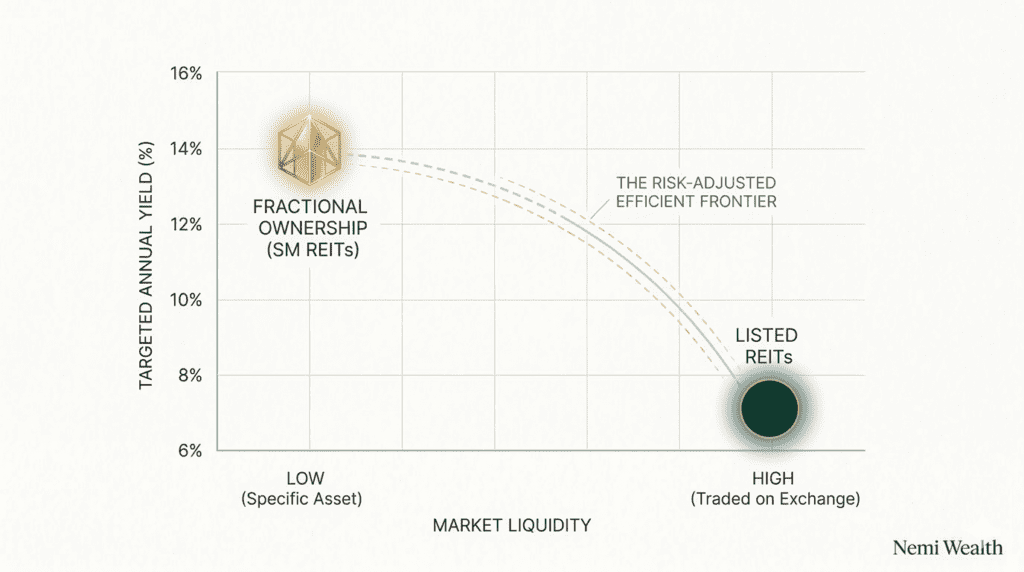
Expert Insight: Smart wealth management isn’t about chasing the highest yield; it’s about the “Risk-Adjusted Return.” A 14% yield is meaningless if the asset is illiquid when you need to exit.
💡 Mid-Blog Break: Join the Community
Want to see these concepts in action? We break down real-world property deals and market trends daily. Join the Finanshull Community on Instagram for bite-sized wealth insights and join 600+ families building smarter portfolios.
The 2026 Regulatory Landscape: The Rise of SM REITs
The biggest shift for investors has been SEBI’s formalization of fractional ownership into the SM REIT framework. Previously, fractional ownership operated in a “grey zone” via Special Purpose Vehicles (SPVs).
Now, platforms must register as SM REITs, ensuring:
- Mandatory Listing: All units must be in Demat form.
- Transparency: 95% of the assets must be completed and rent-generating.
- Governance: Professional managers with a minimum net worth and track record.
While this adds safety, it has also raised the entry barrier to ₹10 Lakhs. This move clearly distinguishes the “DIY” retail investor from the “High-Intent” investor who seeks professional real estate research and structured entry points.
Exclusive Access: Invest with Per Annum Estates
Navigating the world of fractional real estate requires a partner who understands the ground reality of Grade-A assets. To provide our clients with the highest standard of commercial opportunities, Nemi Wealth has partnered with Per Annum Estates.
Through this partnership, we offer you institutional-grade access to vetted commercial properties that are typically out of reach for individual investors. We handle the due diligence, while you enjoy the yields.
Interested in Fractional Real Estate? Fill out this form to connect with our experts and explore exclusive opportunities with Per Annum Estates.
Why You Need a Wealth Advisor for Commercial Assets
A professional wealth advisor at Nemi Wealth adds three critical layers of protection:
- Due Diligence: We look beyond the “brochure yields” to analyze the underlying lease renewals and property maintenance costs.
- Tax Optimization: REIT distributions have complex tax components. We ensure your post-tax yield remains efficient.
- Portfolio Rebalancing: Real estate is a “lumpy” asset. We help you balance your liquid mutual funds with these semi-liquid commercial holdings.
Final Verdict: REITs vs Fractional Ownership?
- Choose REITs if: You want daily liquidity, a low entry point, and a completely hands-off approach.
- Choose Fractional Ownership if: You have a ₹10L+ surplus, a 5-year+ horizon, and want the higher yields associated with specific Grade-A commercial assets.
Refer to the latest SEBI REIT Regulations for official compliance updates.
Conclusion: Don’t Invest in Bricks Without a Blueprint
The debate of REITs vs Fractional Ownership isn’t about which is “better”—it’s about which fits your unique financial architecture. In 2026, the complexity of the Indian market requires more than just a login to a platform; it requires a strategy.
At Nemi Wealth, we don’t just sell products; we provide clarity. We help you navigate the nuances of commercial property investment so your wealth grows with consistency and care.
Ready to build a resilient real estate portfolio? Book a Personalized Wealth Consultation at NemiWealth.com today.